Showing posts with label Wudewasa. Show all posts

Sunday, May 31, 2015

Down in the Cryptodumps, part last: Stuff that Ivan was reading.


Last entry on the big pile of miscellaneous cryptozoological chaos which accumulated in an anomalies dump box with no filing. It gives me GREAT pleasure to wrap this small part of the four dump boxes up. 
Most of these things to follow are bits which I found in the SITU files [also chaotic there] and thought interesting enough to photocopy before they disappeared beneath the thermodynamic noise content never to break surface again. This particular set of articles/newsclips etc was stacked together in a way that indicated that Ivan had read them together. So, without further delay: 


This is a famous 1910 article reporting on the alleged sighting of a dinosaur in central East Africa. 
I won't have much insight on most of these articles but I believe that I know just a little about Sanderson's opinion of this one. That's because it rested on the authority of Carl Hagenbeck. Ivan saw Hagenbeck as an outstanding example of his own "tribe", animal collectors and zoo providers. If Ivan had an ideal profession, that was his passion. Because this claim of extant African dinosaurs was a claim of a hero, I believe that Sanderson saw it as strongly likely. As he said: "Hagenbeck was no fool." 


..... and once you accept Hagenbeck, other claims, such as this in a 1919 clipping [unfortunately by a much less known guy] are pretty easy to buy into. I am intrigued by the fact that the location here is Congo --- almost right on top of the claimed area of our later Mokele mBembe claims which got Roy Mackal, Richard Greenwell, and Herman Regusters exploring there 60 years later. 


Ivan didn't have this drawing in these files, just a typed version of an 1819 report of an African explorer traveling up the western coast, and once getting to Gabon, hearing tales of a giant "ourang-utan" called the "Ingeena." The illustration is from Paul duChaillu's book about his extensive [and amazing] travels through central Africa and could fairly be used to illustrate this 1819 claim. In those days, "we" had discovered the Orangutang but not yet the Gorilla. In Africa tales were however coming in that there were two "mysteries" afoot there. The "Lesser Mystery" turned out to be the Chimpanzee. The "Greater Mystery"= the Gorilla. 

The 1819 story told a weird tale of the Ingeena being almost impossible to fight due to its incredible strength, but that you could win due to its stupid imitative behaviors [the origin of the idea of "ape-ing"]. The Ingeena it was said would see us carrying wood on our shoulders and pile so much wood on its own and carry it around endlessly, that it would exhaust itself and you could dispatch it. Other ridiculous claims like this were also made. 

These tales sound so much like the primitive ideas that we had about the Gorilla that it's hard for me to credit them with anything else ... but Ivan seemed looking at them as if they might hint of a "third" mystery ape. 


An 1816 article [typed only] was in the pile. It spoke of a Flathead River, WA experience reported by hunters in the wilderness. Allegedly a bear broke into their camp and grabbed one of the men, then rose on two feet and ran rapidly away on a two-legged sprint. The illustration above is of the recent case of a urban-going bear which walked two-legged all over town. So, bears with a reason [this one had both front paws damaged] can walk on twos just fine. 

So, it's possible that the hunters' tale of the temporary abduction of one of their buddies was true. What one wonders however is whether the Bigfoot Albert Ostman tale decades later relates to this at all. Did Ostman have a bear encounter and embellish it by morphing it into Bigfoot? Ivan doesn't tell us why he was interested in this. 

There was a 1781 report from Quebec with quite charming descriptions of [as far as I'm concerned] walruses and lake sturgeon --- both of which had wowed the writer [he considered the walrus a sea monster]. The diagram included above is my addition not the writer's. 


The writer also said that there was another mystery beast called the seawolf --- again no illustration, so I've appended one sort of old representation of a seawolf. Frankly the author's description sounds like neither the beast above nor my own favorite seawolf [the Wasgo/Sisiutl] but rather another form of walrus-like creature. Why was Ivan interested? Who knows?


A 1778 article described encounters with a wildman of the Pyrenees Mountains. In this case my appended picture isn't far off. Here's a quote: 

"In the year 1774, a savage, or wild man, was discovered by the shepherds, who fed their flocks in the neighborhood of the forest of Yuary. This man, who inhabited the rocks that lay near the forest, was very tall, covered with hair, like a bear, nimble as the Hisars, of a gay humor, and, in all appearance, of a solid character, as he neither did, nor seemed to intend, harm to any body. He often visited the cottages, without ever attempting to carry off anything. He had no knowledge of bread, milk, or cheese. His greatest amusement was to see the sheep running, and to scatter them, and he testified his pleasure at this sight by loud fits of laughter, but never attempted to hurt these innocent animals. When the shepherds (as was frequently the case) let loose their dogs after him, he fled with the swiftness of an arrow shot from a bow, and never allowed the dogs to come near him. One morning he came to the cottage of some workmen, and one of them endeavouring to get near him, and catch him by the leg, he laughed heartily, and then made his escape. He seemed to be about thirty years of age." 

..... the author then went on to assume that this must have been a human abandoned in the forest long ago, who grew up subsisting on local plants. {Not too long thereafter, in early 1800s France, such a "wolfchild", the "Wild Boy of Aveyron", would become the most famous such abandoned survivor in the world, if you discount Romulus and Remus.}

Ivan probably saw in this story a possible primitive humanoid, his favorite of which was the Wudewasa --- and who knows? maybe he was.


The reference to "nimble as a Hisar" flummoxes me, and the widest stretch that I can come up with there is that it could be slang for the fantastically successful and agile Polish cavalry, the Winged Hussars. These forgotten troops were essentially invincible for 100 years of fighting during the 1600s.


The next bit was from the journals of Alexander Henry and David Thompson, 1799-1814. This reference was by Henry, and to the local Native American "Saulters" of the Northwest Great Lakes, that an animal was known there at that time called by them Kitche Amick, or, a giant beaver. I always thought that this sort of thing was a joke, forgetting that such animals DID exist in palaeolithic times or a little earlier. The tale here was of an armed Saulter seeing an animal on the water which he thought was a moose, but was then seen to be a giant beaver. These animals, being felt to be spirit animals, the Saulter refused to shoot. {Saulter is the old French name for the Ojibwe.}


Second to last is a letter in Ivan's files from a guy named Curtis L. Gibson. This letter [sent to someone else] Ivan had copied to his Thunderbird file. The fellow, who I've never heard of, stated plainly that he was an authority on all Fortean Lore {Wow!}, had neatly wrapped all cryptozoology up in a three-point nutshell. Ready?

All cryptozoological claims are due to one of three things:
1). "natural" biological species not recognized by zoologists. He gave as examples super-condor, sea serpent, sasquatch, and a subclass of this category including things like mermaids and satyrs. He kind of lost me there --- biological or not, big fella?
2). "metempsychic creatures": everything you can imagine with "were-" stuck in front of it. These things are completely physical, and only [violating all reason, but a casual matter to Gibson] morph into entirely different forms whenever they want to. He also had a subclass here which included witches, who he said were "slightly more supernatural" --- I can't wrap my head around that and am not sure I want to.
3). Animate robots which are the products of UFOs, and probably left behind by them, or possibly similar creatures which have been inserted into our environments by some technological intrusion. I suppose that you COULD explain about anything with hypotheses like that.

He then comes SLIGHTLY more down to Earth by discussing some claims that the original letter writer posed to him.

The first was that there is no doubt that Satyrs "still" occupy the desert area of Babylon. He said that he had explained this all in his earlier article in Explore The Beyond magazine in 1960. He based his certitude on the sighting of such by a British traveler whose story he read in an unnamed book, PLUS the Bible says that satyrs will be the eternal inhabitants of Babylon along with bats. He does seem to have great trust in biblical things.

His second topic might have more legs, or wings. It was about the large salt desert bird nests found in Utah. The crypto part of this was the flurry of letters he said his article got about these things, which included thunderbird sightings in that area.


He followed that up with a report from a man in Canada who said that he had seen giant birds several times at a lake there {please tolerate the Japanese film monster picture; his claims weren't that big.} Gibson refused to name the exact location as he did not want tourists crowding in there and extincting the animals.


Apparently some winged creatures were visiting the St. Louis region at that time [c.1971], and he thought that he had the solution for that. {Buckle up on this one}. He saw this as a future projection coming back 100 years or so in time. But that's not all of it. Such things happen when a member of a cult merging Christianity and Trance Exercises doses off [in Church --- he said it, not me]. If this fellow is of exceptional psychic strength he will create in his dreams physical manifestations which will appear not in his own time, but in the past.

Uhhh.... OK.

Lastly, he allowed that many of our unusual creatures past and present have been the aliens abandoning their pets. When they do this in pairs or more, these animals will breed a new colony of alien animals sooner or later to be seen by us. This explains most of Earth's humanoid species.

Uhhh... don't bother to get up, I'll let myself out.

One wonders how much of this Ivan paid any attention to, or why he had it in his notes at all. Maybe the Canadian thunderbirds.


The last thing for today was not during Ivan's period --- just a note stuck in among the rest.

In 1985, at a campsite near Greenwater Texas, a couple said that a big [8-foot] hairy [brown curly] heavily built [must have weighed a ton] bear had strode into their camp and --- ready?--- asked them if they had permission to camp there. Not believing their protestations, the bear told them to get off the premises. To hurry them along, the bear threw rocks at them.


A Narnian Bear in Texas ... THAT's a tale that I can get behind.

Peace, folks.


Sunday, April 19, 2015

DOWN IN THE CRYPTO-DUMPS, part three: Hairy Humanoids.


OLDEN TIMES:

Another one of our mysteries which is set in stone in the ancient mind --- either those old folks had no clue whatever, or we don't.

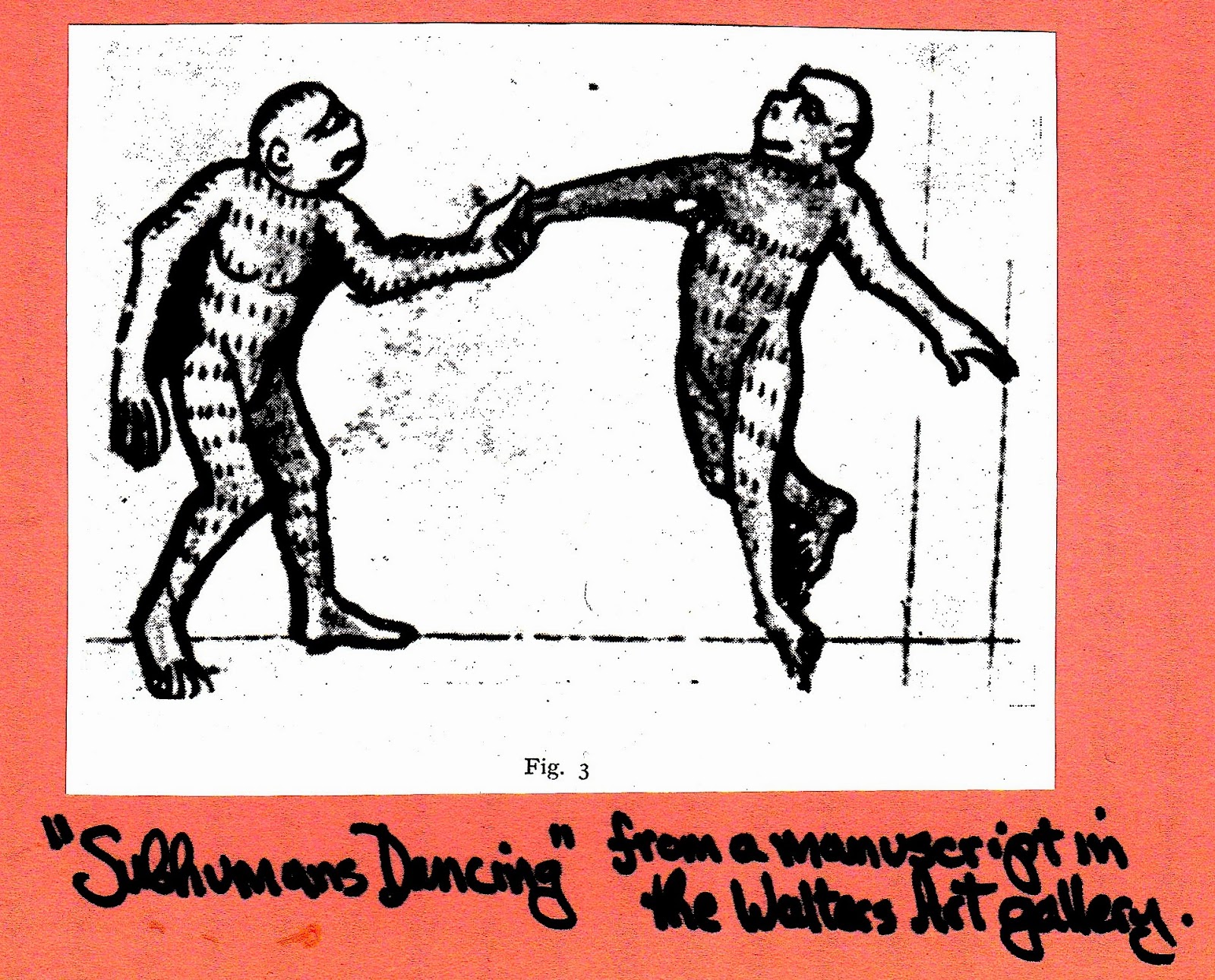
Ivan had several classic illustrations of hairy wild men which formed part of his ideas on the "Wudewasa" of Europe's past, and I'll just post a few here. The above is, I believe, a fragment of a painting study by Hans Durer {I've never heard of Hans Durer; Albrecht Durer yes.} .


All of these are interesting, but the very bottom drawings intrigue. I notice that the picturing of the Ourang-outan is quite like the drawing of the wildman by Bontius, and that slides right into the drawing by Gesner of Breydenbach's apeman. This in turn reflects upon the next picture.

These are illustrations for Breydenbach's Travels in the Holy Land. Our wildman is at the bottom right, and it, if just an orangutan is pictured with a tool and leading a camel. Well, that is at least odd. Other than the "orangutan/wildman", the camel, giraffe, crocodile and long-eared sheep seem uncontroversial. But what about the giant salamander and the unicorn? The unicorn has as "Narwhal-looking" a horn on it as any I've seen. Is Breydenbach just a wholesale liar?? He states unmistakenly: " These animals are truly depicted just as we saw them in the Holy Land." What's going on? The only way that I can think to rescue his reputation would be to say that he visited some notorious stuffed animal museum which contained real and whizzed up animals.

........ or he could have really seen a unicorn and a giant salamander.

But we don't want to think about that, I guess. Too Out Proctor with too little data.

Alright. Pushing onward into the Bush: GIANTS.

Ummm.... ugly. Can The True and The Ugly be one? Though Plato didn't think so, {he of "the good, the true, the beautiful" idealism}, he must have not taken himself literally in the popular definition sense of beauty, since, despite what the guy in The Princess Bride said, he was not a moron. Our Native Americans believed in a true race of giants and one of their artists is telling us that we are now looking at one. ... Sasquatch with a shave and a haircut??

Ivan published at least three articles in PURSUIT on the subject of Giants. The first claimed that Lundy Island [a small piece of land in the general gap between Wales and Cornwall] had two ancient coffins containing two eight-foot skeletons plus "sacrificed slaves". Upon trying to track this claim down, SITU got nowhere except to hear that the original writer of the newsclipping got his "data" from an "older clipping" and "reference books", all unnamed and unfound.

A second article listed several dispersed claims. a]. 100 miles south of Tug Hill, PA remains of a people of giant size; b]. Sayopa, Sonora Mexico old cemetery of burials of men averaging eight feet; c]. El Boquin, Chontates District, Nicaragua gigantic man with head missing. {Ivan noted that Chontates is an indian word meaning "wildman"}; d]. Island off southern Florida eight foot tall human skeletons embedded in the sand; e]. Tioga Point, Bradford county PA 68 men buried in a mound, averaging seven feet tall; this last group was said to have evidence of horns on their heads. ... I think that I'll pass on these ... for more than one reason.

The third article was an examination of a claim repeated by Ivan himself in his classic Abominable Snowman: a Legend Come to Life. In that he spoke of a giant skull found during WWII on the very western tip of the Aleutian Island chain. The catalyst for this PURSUIT article was the appearance of an old Sanderson acquaintance who was on site when the thing was uncovered. This man had scolded Ivan for not asking him about the claim before publishing it in his book. Ivan retorted: "I didn't know you were there!!" The man [kept anonymous by Sanderson] went on to describe uncovering the damaged and degenerating skull of what he called an Icthyosaur [Ivan disagreed with that identification while buying that this thing was not human], which had lost part of its beak, and was in the process of losing the rest. The seamen were referring to it as The Giant, while not knowing what they were talking about. Ivan then rejected the spectacular claim, and with the new data decided that something like a bottle-nosed dolphin was a better guess.

There were also two articles from something called Forgotten Ages. These things were entitled "The Sons of Goliath, parts one and two".These articles were loaded with giant claims and far too dense for me to detail here. I'll give a too-brief thumbnail. Part one was more worldwide while part two was almost entirely US focussed. Part one listed claims of the following sort: a]. 1928 Ecuadoran Central Railroad blasting crew--- eight foot and nine foot giants. b]. about same year, Gargayan, Philippines --- seventeen foot tall skeleton; c]. also same period, Ceylon --- thirteen foot skeletons; d]. 1960 Tura, Assam, India --- eleven foot skeleton --- "authorities" dismiss it as "only" the bones of an ape ... uhhh, just an eleven foot ape? Sure, no news there; e]. 1969 Terracina Italy --- fifty tiled coffins each containing a skeleton between 6 1/2 and 8 feet tall; f]. 1891 Crittendon, Arizona --- sarcophagus with skeleton 12 feet tall; g]. 1911 and 1931 and 1939 Lovelock, Nevada --- several skeletons and mummies between 6 1/2 and 9 feet tall, between 8 and 10 feet tall, and one seven feet seven inches; h]. 1879 Brewersville, Indiana --- number of skeletons one of which was 9 feet 8 inches tall; i]. 1925 Walkerton Indiana --- eight skeletons 8 to 9 feet tall; and eight more instances, most of which were from Minnesota. In one of those "mound stories" it was insisted that among the remains were the bones of HORSES despite them not being native to the continent.

Part two of this hard-working review piece, concentrated on the idea that not only was the North American continent littered with the remains of giants, but that the Native Americans knew this all along. These giants went by the names of the "Sitecah" or the "Allegewi" or the "Telligewi" [among doubtless others]. They were considered to be the legendary opponents of the current tribes, of great size, fair skin, outstanding understanding of technology, and the builders of the mound culture. The academic archaeologists and anthropologists cringe horribly at even the thought of this, as it is academic cant that the Native American peoples built all of that themselves --- I by the way am happy with the thought that the direct ancestors of the current peoples were the Mound Builders, but in the spirit of Charles Fort severely disapprove of having such conclusions as basic "untouchables" built right into the psyches of a whole tribe of academics by training [programming]. It should at least give a little pause when native elders and shamans tell you a different story.

The part two goes on to fire even more shots across the academic bows, bringing up the much argued "Chinese exploration of the Americas" as claimed documented in the Shan Nai King. Herein it is claimed that America was well explored in the 2000BC era, and two areas of Giant inhabitation were found [The East Coast and the Western Deserts, if you're interested]. The Chinese called the latter "The Great Men's Country". There was also a somewhat lengthy description of something that has totally eluded me over my 75 years --- the lost work of a student of Plato, Theopompus of Chios, who allegedly wrote something called the Meropidae. {I've got to look this up and see if it's even real}. This thing, a dialogue between King Midas and the Satyr Silenos [THAT would have been one great conversation to sit in on --- hah!], purported to describe the inhabitants of the land across the ocean. Guess what? They were giants. ... and two types of giants. Supposedly, they came across the ocean once, landing in Hyperborea [Great Britain], whereupon they were confronted by a happy and strong people [The Druids no doubt].

Well, much fun. I haven't a clue as to whether any thing of this is real, except one thing: Native American legends are rife with images of physically real large humanoid somethings-or-other having intelligence. How does that relate to Sasquatch? That's your job now.


CHINESE WILDWOMEN: Some time ago on the blog I presented several entries on the materials in some rare Russian monographs held by Ivan in his collection. Among the many fascinating things in those books were tales of violent aggressive female Yeti/Almas/whatevers. As you see below, they seem to have shown up again.


This should be expected I guess, as even Bhutan has memorialized the wild female side of this exotic mystery in its postage stamps.


SHIPTON: 
Interesting to me to read of an interview with Eric Shipton, being as his famous Yeti print is such a big deal in this ABSM data bank. 


The rest of this small article continues below --- I couldn't get the scale correctly matched, but it's the same article....


I, as always, am puzzled by things that more veteran researchers would not be. My puzzlement here is why Shipton showed a "human" proportioned footprint rather than his famous "ape" proportioned one. This lecture would have taken place in about 1975, as the article appeared in Bigfoot News of January 1976.


For those who don't know what I'm talking about {rest easy, most people don't know what I'm talking about}, the above is the famous photograph of the track. As you see, it's not very much like a humanlike foot, but much more resembles that of an ape with a possible prehensile big toe. Why would the aging Shipton not show his classic picture?, or if he did, why would veteran Bigfoot researchers speak of it as a human foot, albeit kingsized? Sometimes I think that the world is playing pranks on me ... Whoa! Can't go that route! Not only Out Proctor, but LOST Out Proctor! 

A SAD DEBUNK: 

..... a sharp-eyed researcher spots a hoax.


This letter also relates in a way to a small packet of letters exchanged between John Green and Sabina Sanderson [just post Ivan's death], concerning their shared belief that Peter Byrne was untrustworthy as an ABSM researcher, in the particular instance of the famous old "Jacko" Bigfoot case. {I'm not going to wash that dirty laundry here, just letting you know that the Sandersons and John Green didn't hold Byrne in high regard. The letter above by the way is by neither Green nor the Sandersons}. 

HAPPIER WILD STUFF: Percy Fawcett's Amazonian Giants. 


If you can't trust this guy, well at least don't tell him that at the local saloon. 


A map sent to PURSUIT purported to focus on this mystery --- frankly not too closely, but it's fun anyway.


This is the internet version of the location of the Guapore River bordering Brazil and Bolivia, from which Fawcett turned northwards towards the Machado. The correspondent sent this map below to illustrate the encounter area where Fawcett and his team were abandoned by the locals to face the violent hairy primitives alone. 


All readers should pack their bags and get their tickets and go exploring. Hey! What kinds of Forteans are you anyway!? 


The scenery is beautiful and there's a good elevated butte on which you'll find Challenger's Lost World. So get going! 

YOWIE. 

No, that's not a comment on my previous enthusiasms. But the Australian version of Yeti might feel that way. There were two Yowie things in this cryptodump. The article claimed to be able to characterize the Yowie by comparing many witness accounts. And the answer is:


That sort of approach is something that seems fairly rational and sort of "proto-science", if the credibility quotients of the case reports are good. The following newsclipping however pushes things beyond comfort zone to say the least:


Ummmm.... dropping down to see what's happening eh?? 

The Yowie subject did mention an oldtimer character who seemed to have something to do with this cryptomystery though: H. James McCooey.


Though appearing a bit disreputable in the picture above [and in fact having all manner of rough up-against-the-law claims against him], McCooey seems to have been a legitimate accomplished animal recorder and collector and species finder. In short, he was a heck of a good old-style in-the-woods naturalist. McCooey said that he had collected many stories of a large Australian ape and had seen what he thought was the animal himself. A lot of this activity was in the mountains of NSW. 


Another good spot for you guys to go exploring: the Blue Mountains. 

Whether we find the Yowie or not, I liked the following case just slipped in quietly at the end of the article: 

.... High Strangeness .... pure oxygen for the soul. 

And with that I'll give us both a break. 

Not sure what's next in the crypto-dump pile. Some "thing" will doubtless pop up.

Peace. 

Followers

Blog Archive