Showing posts with label Meteors; Meteorites; Aerolites; R.P.Greg; Star jelly; Falls from the Sky.. Show all posts

Tuesday, August 21, 2012

Cosmic Chaos or Contrived Confusion?, part Three, I think.


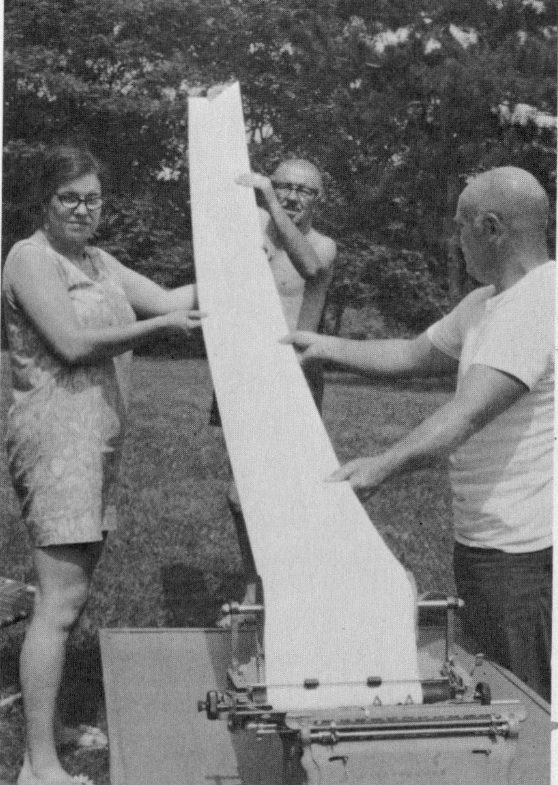
Ivan Sanderson was fascinated with the tales of things falling from the skies, which at first impression should not be falling. He invented a word "Fafrotskies" to shorten up "Falls from the Skies". He collected a lot of incidents, and here he is [above] with about half or less of his computer paper listing of the "Things", as he liked to call such weirdoes.

Sanderson delighted in old sources like RPGreg's catalog of "meteors" and falls, which we have been discussing. Last time the topic was "slags" and other igneous stones. This time it's organic slimes/resins and "star jellies".


The top photo of the three is a bubbling bitumen pit. The next two are types of things sometimes called "star jellies", or just "blobs". Greg's catalog listed bitumen falls in 1796 [Northern Germany] and 1822 [ Christiana, Norway]. Bitumen is a heavy dark tar and pretty unlikely to have survived atmospheric entry under almost any circumstances. "Resin" is said to have fallen in 1824 [ Newhaus, Bohemia] and 1857 [ Kaba, Hungary]. In the Hungarian fall, the resin was described as running through the stone... peculiar indeed. In 1806 [ Alais, France], a "carbonaceous" [carbon-rich] stone fell, but it's properties were not listed. With the exception of the latter, none of these falls makes sense as a meteorite.

"Jellies" were seen to fall [allegedly] in 1718 [ Lethy, East Indies], 1803 [ Silesia], 1811 [ Heidelberg], 1819 [ Amherst, MA], and 1835 [ Gotha, Sweden]. The 1718 fall left a "jelly-like mass, silvery and scaly" --- make of that what you will. Could either of the star jellies pictured above be described as such?? Maybe. The 1803 fall fell on snow and proceeded to burn. After the burning was complete, the next day was found a "jelly-like mass" sitting on the snow. Weird-plus. The 1881 fall just says "a gelatinous substance fell" [Greg adds a "?"]. For Amherst 1819, there was a violent explosion after which "a gelatinous substance" was found. Gotha 1835 says flatly: the "jelly-like mass fell three feet from the observer on the ground with a loud noise". If that last case has strong "credibility", then we are in trouble trying to sweep the weirdness seeming to permeate these incidents away.

The "Star-Jelly" concept has always left me in an extremely doubtful stance. The "blobs' seem extremely unlikely candidates for surviving atmospheric entry, and some natural blobbishness IS known to exist in normal biology. But if the 1835 case would be true, all of a sudden I am in another nook and cranny of Out Proctor [translation: I haven't a clue as to what might be going on].


Let's add a few more anomalies from Greg and call a halt to this topic temporarily. I'm sure that you're getting tired of it as it's [perhaps] not as exciting as dragons, druids, or aliens  --- but if you use your imagination, you can speculate that any or all of dragons, druids, or aliens did all of this. So it's your own fault if you're not excited.

As to other "falls": Greg lists some instances of extremely hot stones, but also two instances of very COLD stones. What can THAT be about? There are meteor-associated hail storms, where the hail contains at its core small stones, iron pyrites, or METAL !!

One meteorite fell so softly that it didn't shatter the ice beneath it. One landed and "rolled" along a meadow for a while. One just sat in a meadow glowing. One scorched the vegetation, another hit a cow and set a haystack on fire, another shattered a mast at sea. The idea that meteors don't strike people is controverted by the claims in the catalog as there are several such instances.

Also, and perhaps most pleasing to me, there are two Green Globes and one Blue one, which meander overhead, leaving no trail nor having any tail --- just a sharp Ball of Light. One of the French scientists is firmly convinced that some of these meteors are Earth-circling satellites and even calculates orbits. One set of optically aided triangulations [apparently] gave a size to one such "orbiter" of 200 miles in diameter. Your choice: a). he got it completely wrong; b). we just missed being really clobbered by a devastating asteroid; or c). The Mothership.


I'm through with Greg's catalog, but I want to add something. While thumbing around Ivan's Fafrotskies files, I came across a letter --- didn't seem to me to be Fafrotsky, but that's where Ivan had put it. I scanned Ivan's books Things, More Things, & Investigating The Unexplained and didn't see it used. He probably DID use it somewhere, but I've not found it. The letter holds no information on year or location, but Ivan apparently knew the author/observer [there's a hint that there's a cover letter which seems to be lost]. The incident goes thus:

This is noon outdoors in bright sunshine. "The thing appeared silently. It was just THERE at arm's length, right in front of my nose, buoyant like a soap bubble, but cellularly, semi-transparently solid. Bone white color, baroque shape, roughly 5"x6"x4 1/2", structured somewhat like clustered snowflakes or like crushed cornflakes loosely poured into a heap. Not vapor, not smoke, not ANYTHING when I placed my palm in connection with the underside. It floated in my hand. No sensation of touch. No heat nor cold; no NOTHING! It was just there. Of the senses, only vision registered. It tended to adhere, as though with very faint magnetic attraction.

"After several seconds and at various points of contact with my palm there appeared to be innumerable micro-explosions, or, shall we say, disintegrations that were completely soundless and were not felt at all, only a visual phenomenon. No detritus resulted. Had there been sound I think it would have been miniscule but with vigor as of Chinese firecrackers. With each "disintegration" the thing jerkily settled, if one can imagine a weightless blob responding to gravitational pull. After about 30 seconds there remained but a pinheads sized white sphere, apparently stable. Seconds later, as I started to touch the white ball, it disappeared".

Hmmmm.... weird plus? or something that we know, but has escaped my "education"? Seems extremely bizarre and well-witnessed.


I'll leave you with a folk legend. In the African culture of Togoland, the people have the belief that far back in their ancestors' time, "magic" stones fell from the sky. They appropriately called them "Skystones". They were pure white quartzite in composition and holed to wear as Good Fortune amulets. The above is from my own collection of odd artifacts, and although I don't wear it as an amulet, I've had a pretty fortunate life. Proof positive "data", eh?

Well, it's a nice thought....


Friday, August 17, 2012

Cosmic Chaos or Contrived Confusion?, Part Whatever This Is.


Today the not so brilliant-sounding topic of "slag falls".

I'm actually not too apologetic about being interested in slag falls, because ... well, they [in some definitions] have no business happening.


Let's look at what SHOULD be going on. These are a couple of photographs of things in my collection. The object at the top is a typical meteoritic "iron". This one is from a fall in Gibeon, Namibia sometime prior to 1836. It's been sliced to show the tell-tale [and mysteriously fascinating] crystallization "designs" called the Widmannstatten Patterns. Iron is a major heavy element in the Universe [formed in Star cores as an elemental fusion dead-end product, so it accumulates...when big stars nova, Iron is distributed widely to serve as heavy stuff for new bodies of all sizes]. A good deal of asteroids and comets is, in theory, Iron, so when they bust up [forming "meteors"], we get a lot of "iron raining down" and burning up as a pretty red-orange. THAT's what's supposed to happen to make the Universe make sense.

The second photo is of an interesting object on the left and a dull one on the right. The interesting looking one may well not even be a meteorite, as it is a "tektite". It's a relatively light "glassy" sort of thing, which may not have rained down, but rather be a product of fused sands caused by a big meteorite "splashing" in the desert. It's a mystery in its own right. The dull "pebble" is the meteorite. It's a "rock". It often will have little raw-iron crystals embedded in its matrix, but is generally a stone composed of a variety of "normal" elements. If it's "copper-heavy" it will burn green as it burns up in the atmosphere. I don't remember the vivid red element off the top of my head [Lithium?], but you see these colors all the time in fireworks. Being an old environmental foggie, I shake my head at the waste in these celebrations. But as to meteors: when such a "stone" burns up, it often shatters and its pieces burn with different colors due to the different preponderance of elements in different pieces. So like the wonderful fireball that I once got to see, they may "toss off" colored balls of green and red and yellow as they fly. Beautiful, but normal.


On the other hand, any of this sort of stuff falling down out of the blue is NOT normal, or shouldn't be. The top picture is Pumice. The middle picture is Scoria. These two things are the products of violent igneous activities associated with vulcanism and under-Earth magma-associated processes. The only way that such objects should come down to Earth surface from Space is if some part of an extraterrestrial, probably extra-solar, planet was drifting into the Solar System and intersected Earth orbit. Even then, the atmospheric trip down would have given such stones a hard black fusion crust, like my "pebble" has. Or some Earth volcano could have belched so hard that it nearly orbited some debris... but you'd think we would have noticed. But Pumice and Scoria are claimed as meteoritic falls.

The "worst" is picture three: slag. "Slag" is a garbage word encompassing a lot of different things. What they have in common is the thought that slags are the useless conglomerate melted debris of human furnace technologies --- could be metal-working, or could be ceramics or glass. Whatever the technology, WE are involved and our handiwork is evident. Therefore, if "slag" falls, we've a big mystery on our hands.

RP Greg's catalog lists seven igneous stone or "slag" falls, or somethings like the types of things we've discussed just above: 1438// 1771// 1819// 1820// 1827// 1840// 1842. 1438 was like Scoria. 1771 was a sand-like pebble. 1819 was a Scoria. 1820 was a Pumice. 1827 was a "compact Charcoal". 1840 was a kind of slag with silicates, soda, and a "white shiny enamel" on the outside! [deserves an exclamation point]. 1842 was a Basaltic stone which was hot to the touch. Those are a lot of weird sky-droppings.

Even though most of those are "volcanic" rather than technological, they present enigmas all around. Of course it could be that they are all bogus.


But this is what interests me about the "shouldn't be there" falls in the Greg catalog: falls of this kind have been encountered many times in the post-WW2 UFO period. Slag falls. These things SHOULD be easy to disregard as errors. They aren't quite.

The guy in the picture above is Dr. Nicholas Kohanowski of the University of North Dakota. He was probably enjoying a relatively peaceful academic life when, in "1959", four cases of "slag falls" from his home state of North Dakota came across his desk. These falls had occurred in 1940// 1953// 1957// and 1959. Kohanowski, as a professional geologist, felt that he could rather easily "understand" these events and place them in the conventional world of common reality. He couldn't. [actually, Kohanowski got entangled in this business of strange falls in 1957 due to the Langdon, ND fall, and then the 1959 one was brought to his attention in turn].

The 1940 [Price,ND], 1953 [Breien,ND], and 1957 [Langdon,ND] materials were very similar. They contained no uncombined Iron, no uncombined metals at all, some glass, and were largely composed of the inorganic mineral Melilite, or one of its close cousins. Melilite is a silicate containing many metallic cations, but in proportions that actually make it fairly rare [the Greeks called it "honey stone", thus meli-lite.] It is in both metamorphic and igneous rocks, and seems to be the product of high heat processes. It is also found in some chondritic ["stoney"] meteorites, a fact that I don't believe Kohanowski knew at the time. At the least, we can say that these falls were not technological "slag" as the debunkers wanted to classify them at the time. To Kohanowski's credit, he said that although his lab analyses did not allow him to explain everything about these things and how they "arrived", his primary working hypothesis was that they constituted a new form of meteor. This would be unusually low density and would usually burn up completely, he conjectured. Some things, like the "glass", patches of "carbon", and, in a "slag fall" from New Jersey, an alleged lot of copper, remained puzzling to him. Other mysteries involved why these "slags" burned so long and so hot on the ground, and why their "landings" didn't knock some sorts of "craters", even smallish ones, in the ground.

1957 had the Langdon fall, the Caldwell, NJ fall, a slagfall in Webster, NY, another in Bedford, PA. NICAP advisor Professor Charles Maney was coincidently testing another from Toledo, OH from 1956. Lots of weird stuff was falling out of the sky. These things don't have to have anything to do with UFOs or ETI of course [although Ivan would like that], but here and there comes a curve ball. Lee Munsick, Donald Keyhoe's earliest right hand man [before Dick Hall showed up], had gotten samples of the Caldwell fall and was asking all around for opinions on it. A guy from the Smithsonian said that it was just a "siliceous slag" from some copper-smelting process. Another analyst disputed that the sample had much copper at all, and so was a slag from an iron furnace. When you inspected the physical piece by eye, however, there was an "indentation" in it which looked like it had been made mechanically, and that this odd substance might have been part of something. Yep, those experts can nail these things right down. No sweat. Kohanowski gave it an honest look, and his thermal analysis showed the NJ piece to read like the 1959 [the "different" ND fall] Drake, ND specimen. Hands thrown in the air.....


I don't know how to get a handle on this strange stuff which actually seems to fall out of the sky. I DO know that WE produce some strange-looking stuff ourselves and so we must be careful. The above picture is from "the back" of a glass factory which once existed in the old family hometown of New Martinsville, WV. It has the matrix which contained the "melt" from which the glassblowers sucked out the newly fused glass, and the remnants of the vividly red glass from that batch. When the glassmakers/blowers were done, this "container" must be cracked out and discarded as waste. There were some pretty "alien-looking" materials lying about [if you weren't familiar with a glass plant].

But as to the slag-falls: doesn't it seem that, although some space materials are more common than others, just about any "fall" is possible? Not only Iron/Nickel cores can break up, but stoney concretions, carbon-containing stones, and even I have two specimens containing amino acids and other life-essential bio-molecules. Couldn't a bit of a former life-bearing planet fall down?? Even, yes, a bit of a spacecraft. Greg's slag-falls and igneous rocks are probably a combination of true falls and mistaken pick-ups. Kohanowski's are mainly falls of rare minerals. What was the thing which fell in Hartford,CT in 1960, which we talked about so much here a while ago [the TTownsend Brown Affair] ?


Maybe a picture of Texas Bluebonnets in the Snow will soothe our fevered brows.

They say that white stuff fell out of the sky.... if you try to pick it up, it melts right away, leaving only water.

Sounds unlikely.

Monday, August 13, 2012

Cosmic Chaos, Addendum Two.


A pretty far Out Proctor "meteor" situation:

I was finally getting the last of Ivan Sanderson's three-ring notebook files on the archive shelving [this is the main sort of "work" that I've made a priority while in Michigan this time], and came across one with a little remark about meteors on the bottom of a several subject label. Well, timely... so what the heck, let's look. There were about a dozen meteor cases noted there at the end of this notebook. Most weren't too thrilling to me [although Ivan apparently liked them], but one of them was one of those "What?" types of cases.

This case is actually three [at least observations] which may or may not be related.

June 18th, 1845. Mediterranean Sea. This "case" is in Greg's catalog, but only the first part of it. Case part one: Adalia, Asia Minor [if you're looking this up, it has changed its name in the 20th century to Antalya, after being a famous trade city of the former name far back to Roman times.] A Reverend F. Hawlett, a fellow of the Royal Astronomical Society, was residing in Adalia [marked with the Google teardrop on the map above], when a tremendous flash appeared covering about half the sky in the direction of vision. {today we would have said like a huge aerial firework bursting, but with the difference that the explosive "flower" stayed spectacularly visible for several minutes.} The elements of the slowly expanding flower were of great beauty, shining in red, orange, and silvery-green. The observers seem to have been privileged to witness a great meteoritic explosion "head-on" with dramatic post-dusk Sun illumination. Well, great; would have loved to share in that. But there was more going on elsewhere it seems....

Case part two: the write-up gives the impression that the Reverend Hawlett was interested to receive a letter from someone near Mt. Lebanon [about where the white "burst" is marked on the map above] who reported seeing two luminous bodies "each appearing at least five times larger than the Moon", which flew together joined by streamers and gave the appearance of flags flying in the sky. The main bodies were so bright as to be painful to look at long. They were in sight one hour. This seems to have been witnessed at the same general time as the Adalia sighting. Hmmmm.... that complicates things a bit. One could wiggle around with this and force fit these two together under the bursting fireball hypothesis, I suppose, but I don't like the eye-straining long-lasting brightness part of it.

Case part three: for the same time period, but far to the west near Malta [see the red burst symbol on the map], the crew of the brig Victoria had a little more unnerving experience. They were in dead calm when a violent gust blew --- "her topgallant and royal masts suddenly went over the side". This violent gusting went on for two hours, then dead calm. The crew then felt overpowered by great heat and a sulphurous stench. One half mile from the brig, three luminous bodies rose out of the sea. These were visible hovering for ten minutes [no statement of how they either left or disappeared]. The wind violently returned in the opposite direction to what they had just experienced. Now just a consarned minute!! I was coping with reality pretty well up until then.

And just to further wring out the brain: three days later in the general area of Adalia [not there but Erzeroum], they had been having typical mid-summer days when the temperature dropped off the cliff. It suddenly fell to just above freezing and was accompanied by three days of massive snowfall. After those three days, the temperature shot back up within the day to summer heat levels. Meanwhile over on Malta, the temperature soared far over 100 degrees. You tell me what was going on.

I don't know if any of the pieces of strangeness above are intimately related to one another. But even if they are not, there are at least two bigtime anomalies in there: 1). sudden temperatures dives and rises with massive snow dumping in June in the Mediterranean; and 2). sudden violent gales out of dead calm air, accompanied by luminous bodies rising from the sea. Did Mother GAIA get a migraine for a few days?? Did our Old Earth run into weird space-time rough spot focussed on the Mediterranean at that time? Did Hephaestus' forge start acting up on him?


What'd YOU think, Ivan??


Friday, August 10, 2012

Cosmic Chaos, part one, Addendum.


Hah!!! Wouldn't you know it?! A good friend read the blog entry, and [as often happens with him] thought of a picture that he hadn't "visited" in a long time. It is a painting by the artist Trouvelot of an 1868 meteor shower in Medford, Massachusetts. By buddy, Barry Greenwood, one of the best colleagues that you could have in the UFO research business, and a member of the History Group team which wrote the book, not only dredged out the picture from his files, but figured out just where Trouvelot stood looking at it. It is in the direction, perfectly appropriately, of Barry's current home. Now THAT's synchronicity.

The original blog title was "Meteors Behaving Badly".... yep, these sure are. It's as if a few of them decided that this just wasn't the night to simply burn-up or crash to Earth afterall, and whoop, change of direction they went.

Maybe every meteor has a little Daemon riding it, and when they get coltish in their little aerolitic hearts, they say: What the Hell, I'm doing something else. {This last "theory" is Out Proctor in honor of our friend Kandinsky, who would like some non-UFO thinking on these whacky things}. {If I had a smiley emoticon available, this is where I'd insert it}.


Tuesday, August 7, 2012

Cosmic Chaos?? Contrived Confusion??: Meteors Behaving Badly.


Back at least for a post or two folks. This one was "inspired" by a comment by Ivan Sanderson that he'd been reading an old catalog of meteor sightings by a British astronomer/observer, RP Greg, who had put out his catalog in 1860. Sanderson was of the opinion that Greg had captured quite a few things in the catalog which were not meteors nor meteorites at all. Knowing that our adventurous friend Ivan often let his enthusiasm get the better of him, I wondered if that was just excess joie de vivre or whether there was something there. So I downloaded the catalog.

1860 was well past the time of the controversy of whether meteors were essentially "rocks" which flew about the atmosphere and crashed to Earth. That had been settled by the early first decades of the 1800s. The meteors and the "fireballs" were types of stones, but only certain types of stones. Some types of stones were still "forbidden" to fall. Although a few holdouts wanted them to be blasted out of volcanoes, science had settled on the idea that they were things with their own orbits, which got caught by the Earth's gravity, or just bad luck on flightlines, and mostly caught fire as they rushed through our Oxygen shield. The only questions that these fellows had were regarding whether the stones orbited the Earth, went round the Sun, or had their own eccentricities, even to coming into the Solar System from deep space.

But the science was still young, and several people were collecting every case that they could in order to extract the truths which must be there --- it was good old "exploration time". Greg was one of the catalog adventurers. What did he find??


Greg found many cases and many beautiful sightings of course. As Sanderson noted though, some of the things he found were of mildly puzzling natures, and some were very puzzling. Let's take a look.

In 1858, over Berlin, Germany [yeh, OK, it wasn't quite "Germany" yet...] a fireball was seen. This fireball "burst" twice as it flew, sent out "sparks", and changed directions both times. Well, probably it blew off big chunks of itself and the remaining fiery part angled away according to the laws of motion. Maybe. Could have happened that way. Would have been nice to have gotten an idea of how much change there was. But we'll give the mundane world that one.

1844: Silesia. Object looked like a large bright "lamp". Others described it as "conical" or like a wine decanter. It was red with a greenish-yellow tail. It moved in a curved arc 50 degrees long. Depending on the use of language, meteors are not supposed to move in curved arcs. But, alright, we'll give in on this one too. Let's say it was a fireball moving in what seemed to be a shallow arc, which then disappeared due to exploding at great height.

1758, Dublin, and 1787, Edinburgh: these meteors seemed to descend towards the Earth then [without any explosion] "pull-up" in their flight, gain altitude, and head back towards space. One then blew; one cruised on away. These are starting to push me a bit. I'll go "mundane" on them by assuming that the meteors were really high, the observer positions made them look descending, then they "skipped" off the atmosphere "changing direction".

Now come EIGHT cases, from 1649 to 1844, where the "meteors" are described as moving in a "serpentine", or bounding up and down in one case, style of motion. This is clearly not simple Galilean motion in any obvious way, and it takes quite a bit of "making stuff up" to dispense with the cases. The debunker here must fall back on doubting the witness testimony as to what exactly was meant by serpentine, how up-and-down WAS it?, weren't you just looking at a distorted smoke trail?, etc. I'm not comfortable with just tossing these oddities out.

1839: Naples, Italy. An object with a long train passed across Italy going West to East towards the Adriatic Sea. It then TURNED BACK and flew on a Northeast to Southwest course disappearing beyond the Bay of Naples. Well, THAT would take one heck of an invisible Galilean mass ejection indeed. No, I don't think we have an easy explanation for this one.

1848: Bombay, India. An object as bright as the Moon with bluish and reddish light, burst or emitted sparks. It flew South to North, then making nearly right angle turns, reversed its course and flew back North to South. Hmmm. "Meteor", "Fireball"? Tough to sell me on the mundane here. About all that's left on these last two is to say that they didn't happen. Which is what Phil Klass would have said, or "ball lightning".


OK. We have a few "maneuvering" meteors, anything else?

1850: Penzance-to-London. Object was as large as the Moon, with no tail but a disconnected train of light. It was reddish, bluish, and yellowish. It did not fly smoothly but moved in jerks. It seemed to explode into luminous balls. An explosion was heard c. 5 minutes later. Some scientists said that they thought it had a parabolic orbit [which might mean that it came to Earth from very long away]. Well, just what did the movement by jerks look like? If dramatic, no meteor. If dramatized, yes meteor.

1778: Como, Italy. Fireball. Would move, explode; then fly on, then explode; then fly on, then explode, "moving by bounds and jerks". If it did this many times, then it begins to stretch the fireball behavior assessment. If say, three only, then OK. Maybe.

1843: Westphalia. A "bright round disk" [the 19th century words] suddenly appeared in the Southwest. It flew for 15 seconds and then "dissolved" into small serpentine portions. Very high meteor which blows for some reason that high up? Maybe. Wording is interesting though.

Now there appear FIVE cases from 1686 to 1851 where the objects are described as stationary for at least some portion of their manifestation. The 1686 [Leipzig] and 1847 [Oxford] objects are stated to have remained stationary for SEVEN MINUTES. The Oxford object was apparently a bright ball of light ["bolide"], and the Leipzig object a ball of fire. Stationary objects throw the meteor hypothesis out the window. Seven minutes of "hovering" insist on an entirely different thought process.

1830: Birmingham area. Object about equal in apparent size to the Moon appeared. It moved and suddenly disappeared. It then reappeared on same path, and then shortly disappeared again. It did this as a rhythmic two-second interval change. So, fly two seconds, disappear two seconds, fly two seconds, disappear. Sort of like a dark high-flying object which blinked its lights twice --- my language not theirs.

1832: Delhi. Three balls of light came together and formed a single ball of light. Hmmmm..... unless someone ran the film of a meteor split-up backwards, this "ain't no meteor".


Short, but I'm going to call it a post for tonight. There were some interesting mysteries there, and a couple of obviously maneuvering objects which could qualify as early UFOs. There is much else in Greg's catalog. Much of that is very odd stuff involving "falls". Weird things were encountered on the ground. When I catch my wind, I'll post on the "Fortean Falls" from Greg's catalog.

Forgive the slow pace... Mom's weaker all the time, and one of my brothers has gotten cancer. Wears on this old man. But I'll stay exploring [keeps me alive] and pass the wonders on to you. As an aside, the big UFOs and Government book is beginning to bring to the History Team a lot of nice comment.

Maybe the 4+ years were worth it.

Followers

Blog Archive