Showing posts with label Gul-Biavan. Show all posts
Tuesday, March 11, 2014
A Dark Side to the Disappearance of the Asian Wildman??
Once upon a time in Tibet....
sometime in the 17th century, a Tibetan lama was painting a large wall-hanging Tamka/Tangka [spell it as it pleases you; I've seen it several ways] for meditation within a temple space. Its central figure was probably Padmasambhava, and arrayed about the edges were squares within which other deity-like figures were represented. One, our revered lady above, was Green Tara.
Something happened to that temple. It may have been destroyed or abandoned during the 20th century encroachment of the Chinese, or it may have ceased to exist earlier. The wall-hanging meditation paintings made their way into Nepal. There, the caretakers of the paintings decided that they had no further use for them, and sold them to a westerner. For whatever reason, he simply stored them away ... badly.
After the Viet Nam war, two dishonorably-discharged survivors of that war hung on in south Asia, migrating into Nepal. They turned into "modern-style" Buddhists --- with the shallow mantras of the new agers layered over what were basically good hearts. Desperate to "make a living", the Wisconsin native returned to the USA to set up an Oriental Curio shop, while the friend stayed in Nepal as the acquirer.
There he discovered the 17th century paintings rotting away unseen for many years. Mostly they were tragically unsalvageable. Sometimes along the edges, vignettes were just still "alive". So our Green Tara was cut from the remainder of the decay, and sent on. She was damaged, but unbowed.
Then one day in the 1970s, a young man from Milwaukee and a young man from Kalamazoo decided to meet halfway in Chicago to exchange money for treasure. The ex-Catholic Buddhist and the Irish-Catholic boy from Michigan both thought it somewhat of a hoot that the meeting was in the lower level of St. Patrick's Cathedral. They were sure that the Spiritual World was smiling.
The Milwaukeean brought a dorje, a phorba, a butter-burnt skullcap, a thighbone trumpet, and other wonders in his sack. In his hand was the rolled cloth of Green Tara. ... and so she came to Michigan.
... and what does this have to do with the Central Asian Wildmen? For me at least it had a lot to do with the issue, and this is withering away now that I'm reading the Russian documents. Tara, for me, personified the sort of Buddhist insight that I felt was Buddhism greatest contribution to world culture: the holding sacred of life in all its forms, and all its relationships. Tara is the life-protecter, the healer, the enlightener of Nature. She imprinted upon my mind the idea that in this Buddhist world, advanced living things would not be deliberately killed. Thus, it seemed to me, any almas, yeti, gul-biavan would stand an exceptional chance at remaining.
The Russian documents tell me that this is nearly completely wrong.
I was reading along in monograph #3 of the Russian Committee, generally enjoying the text although its evidence wasn't inspiring at the moment, when I ran into a depressing run of pages. The content focussed on Tibetan Medicine.
I'd heard about Tibetan Medicine, of course, and how it was split between two "schools" of medical knowledge: healing medicine and killing or "political" medicine. For some reason I had never put this together with my view of the peaceful, life-affirming higher Buddhist ideals. I guess it was because, try as one might, it DOESN'T fit well together. In these pages of the Committee materials, it became obvious that not only was "political" medicine disjunctive with Green Tara's higher ideals [though one can always rationalize War as a sort of re-harmonizing], but even curative medicine was no innocent lamb. In short, the pages talked of using the Wildman as fodder for a certain medical recipe of great monetary worth. ... oh great.
The Text talked of the production of "Mumen" or Moomuyam", and it's necessary ingredient: the boiling down of a "Red Man", or an Akvan.
Well, naive me. I've regularly cursed traditional oriental medicine for aiding in the extinction of many of the Lord's finest creations in Asia, but to extend this to the Central Asian Wildmen still took me by surprise.
After a series of near-ridiculous folk stories about Wildmen, which they said were referred to as "Khivan" or "Akvan", the following quote appeared:
"The Hindu gypsies, Lule, used to be in close communication with the Snow Man, because of that famous medicine, Mume, which was in great demand in the center of Asia, and only Indian rajahs nabobs could afford the price of it. The gypsies, who before the revolution were wandering to the south of middle Asia, used to talk about the Snow Man, but, like the Kurgiis {Kirghiz?}, they don't consider him a supernatural creature."
Then after a few sentences about how some regions view the Snow Man as a spirit and others an animal [the name Khivan allegedly meant animal, but to me this might be a prejudice as there are people named Khivans in bordering areas --- Akvan however is universally a spirit demon], the text turned back to the "medicine".
"The neighborhood around Khakim on the river Karakahl in the Gap of the Duwakh Gara [the Russian transcriber of the original audiotapes was having a losing battle with the names therein], is pointed out as one where there are many Gevs [another name for wild men], and there is an abundance of material for the Mumer. "
That "testimony" ended to be followed by separate things retelling experiences of finding footprints on high mountain glacial snow. These were somewhat interesting even though direct contact was not involved --- I may get to them in a later post. It would have been nice if this was all there was about Mumer, as I wouldn't have even focussed on it at all. But more "testimony" came in from Uzbekistan and the town of Sergan.
In this a man spoke of his father who was very interested in the medicines of central Asia. About Mumer he said:
"This medicine was supposedly effective in all kinds of sicknesses and diseases. I might say that in 1912, one little grain of this mysterious potion was almost one ruble in gold, ... this was certainly a very expensive medicine. ...
"This Mumer was peddled around by the Luli or the Asiatic gypsies. {He then listed several authorities on these claims}. There was a rumor that this potion was procured by the cooking or boiling of a live red man {an Orang-utan?}, but my father had obtained information that this was procured by boiling a red Khivan, or Akvan, otherwise a Snow Man.
[referring then to another book entitled "The Riddles and Demons of Tibet", he went on]:
" On page 344 there is mention of using the blood of Mi-Ge --- that is the Wild Man. By the way, the word Mumeneghe in Kajick [kazhjik] means 'wax from Mi-Ge' and out of this originated, of course, the word that was used before 'Mumer', because it is closer to the Turkoman or Oursbak, or Kirghiz languages. The hypothesis on the origin of Mumer from Mi-Ge throws a light on a whole series of circumstances."
The correspondent then went on to identify an iron-smelting region where once abundant "Akvan" lived. He hypothesized that these smelters produced Mumer on the side as "it was quite a profitable occupation, because each Akvan, when boiled down could produce enough material for some 5000 rubles profit."
Well...Yuk.
The above is a Persian area rendition of an Akvan, portrayed in Persian legend as a demon spiritual being of unfriendly type. Our Wild Man doesn't fit the behavior nor the appearance. But Mi-Ge DOES fit the general concept of an awesome mysterious being. The "Akvan" word could easily have been ported over into central Asia and assigned to Mi-Ge, Yeti, Gul-Biavan, Almas there in some areas.
So what's Mumen anyway? Modern western "Tibetan" medicine persons either feign ignorance or give an obviously wrong answer. The line that they take is that this was a medicine based upon minerals [sorry, that doesn't fit anything], and they base this on the fact that a word "mumen" is a word for {probably, even this isn't certain} Lapis Lazuli. They therefore tinker together several mineral powders including Lapis Lazuli and sell it to you as Mumer/Mumen, the all-curing medicine.
"Mumen" in modern Tibetan means at least two different things: Lapis Lazuli and a Tibetan rodent. Who knows what else it may mean. Tibetan medicine is, as it turns out, rife with the use of body parts of top-of-the-food-pyramid animals. Bears, big cats, yak, even elephant are a few. Using Mi-Ge as part of these potions would certainly fit the culture. I am intrigued by the name of one medicine: "Mig-sMan". It is a potion using Musk and Bear's Bile among other things. Mi-Ge and Mig-sMan ... just a vibe. It is for eye problems. Older thoughts said the Mumen was especially good for ailments of the stomach.
All of this is pretty disgusting to me. The possibility that we enlightened humans could have not merely pressed the Asian Wildman out of existence, but consciously hunted it down for potions, puts me in a bad space where Green Tara's soothing dharmic vibrations are particularly welcome. Along with the minimal research that I did, I found [further destroying my idealism] that although there are proscriptions against killing [especially] wild animals, IF the monasteries really feel that they need such substances for whatever use, there are means of obtaining them.
Literally, "is nothing sacred?"
Sorry to put us through that. Maybe it's important in understanding. Here are some of Mom's doodles of joyful birds to make us all happier.
Peace.
Saturday, March 1, 2014
Rinchen Y-Byambyn and the Central Asian Wildmen
{ first a preliminary note on workload here: I am immersed in the long task of scanning my UFO files with the intention of making them available broadly someday. This task is long and the "after-task" work with the UFOs and Government book group will be longer, so don't look for them on the internet anytime soon. The relevance here is that this absorbs lots of time away from the blog --- I'll do what I can.}
Now to the matter of today: You know from the last two posts that I, after luckily stumbling upon a rare Russian ABSM reference, have been trying to give some of the content for you. After attempting a data summary of sorts from monograph #2, I cracked open monograph 3 and read something that I thought interesting, and maybe new to some of you. This was an english translation of two items about Central Asian ABSM possibilities by the legendary Mongolian scholar "B. Rinchen." After saying a few words about Rinchen himself, I believe that it will be appropriate to just re-type his whole writing here. Normally I wouldn't do that, but this seems like a primary resource which maybe no one who reads this blog has seen, and few people anywhere.
Rinchen was born in 1905 on the borders of Mongolia and Russia to what we'd call middle class parents [his father was a language translator and a public educator.] He "automatically" became proficient in Mongolian, Russian, and Manchu. By the time of the first congress of the Mongolian People's Party in 1921, Rinchen was working there as an interpreter. In 1924 he went to Leningrad to study along with several other Mongolian boys. He, in 1927, graduated [the first Mongolian to do so, I believe] with the degree of "Orientalist", an expert in Eastern Languages and History.
Once graduating, he applied himself to his interests in all-things-Mongolian [literature, ethnography, religion, folklore, and even palaeontology and prehistory.] He became a fiction writer "on the side" and, somewhen between the thirties and forties wrote poetry and novels, one of which is considered essential reading for Mongolian school children in recent times. This book, ZAAN ZALUUDAI, depicts Rinchen's idea of living in the Mongolian prehistoric past. Perhaps I am wrong here, but I see a strain of unity in his interests in how the Mongolian people came to be and his interests in the Mongolian wildman.
In the early 1950s Rinchen studied for and received his doctorate in linguistics --- I believe that I am on stronger ground to suggest that this WAS the first PhD by a Mongolian scholar from a western university. A decade earlier, in 1942, the first Mongolian Russian-language newspaper was published. Its editor: Byambyn Rinchen. [a small point but one creating some confusion now and then: Mongolian is an ethnic group which states the patrilineal name first and the given name second, like we would if we went about calling people "Sanderson Ivan-T" or "Mao Tse-tung". The Russians therefore refer to him, wrongly, just as I have, while his formal name is Rinchen Byambyn --- helps a little when googling. His famous fossil-discovering son is, for instance, Rinchen Barsbold.]
In the intervening years between first graduation [1927] and his PhD [1956], Rinchen pursued many things in his interest to find out everything about his culture and his land. One of these were stories about the Central Asian wildmen. Because he was so highly respected as an all-everything Mongolian scholar, when the Soviet Snowman Committee formed in 1958, they went right to Rinchen for information.
So, here goes with the Committee's "findings" directly from him. He suggested an article that he had just written [1958] on the subject, and followed with a supplementary letter in 1959. The article, the far longer piece, goes as follows:
Title: "Almass, Mongolian Relatives of the Snow Man"
" From time immemorial the Mongolians were aware of wild horses and camels. They also knew of the existence of the wild man whose habitat coincided with areas inhabited by wild horses and camels. The travelers during the Middle Ages who who visited Mongolia mentioned in their accounts that the Mongolians knew of the existence of the wild man who lived on the fringes of the Gobi desert, but somehow this information escaped the attention of scientists.
In Mongolian there is a special terminology for all the wild beasts of the region. The wild horse was known as "takhi", the European scholars knew it under the name of Prjewalski's horse; the wild camel was "khaptagai", and the wild man as "almass". Many toponymical names in these regions where once upon a time lived this (unknown to science, but well known to Mongolians) wild man, bear names which tie in with the Mongolian definitions, like "almasin ulaan khad", red rock of almass.
The late professor B. Baradin was the only scientist who was fortunate enough to meet an 'almass' during his travels .... {at this point either the Committee or the translator decided to omit this story, saying that it had already been covered by Porshnev in an article in Contemporary East} ... booo....
According to the data collected by the late Professor Jamtzarano from 1890 to 1925, the area of the habitat of the wild man became much smaller in size and roughly coincided with the area inhabited by wild horses and camels in the South-Eastern Mongolia.
Brief information on the materials collected by Professor Jamtzarano was published recently in the bulletin prepared by a committee charged with the responsibility of studying the 'snow man'. In the same bulletin was also a brief compilation of the data I was able to get together in 1927. "
{ I wonder if Rinchen collected this wild man data as part of his graduating degree the same year? Seems too much of a coincidence.}
... at this point the committee or the translator shifts into a third party mode for some reason... but I'll still quote it.
" Dr. Rinchen goes on to tell how he met three different witnesses who claimed that they had seen dead and live 'almass'.
One was an elementary school teacher in Gobi-Altai who saw in 1929 or 1930 a dead almass girl who was killed inadvertently by a hunter. He also saw a live male almass.
The second witness was a member of the border patrol who saw three almass and mistook them for refugees from beyond the border.
The third witness is a man who is at the present time working in a pharmacy in Ulan Bator. This man describes how together with three hunting companions, in the mountains of Burkhutoo, in the upper basin of the Deelum-Gol river, they came upon footprints of naked feet in the soft snow. Following these footprints they came within 100 meters of a tall powerfully built man with a shock of gray hair, whose body was covered with dark short hair. His wide shoulders, muscular body, and height [not less than two meters] astonished the hunters. The natives reacted to this apparition differently -- 'Albast -- the spirit of the mountains!' -- they exclaimed.
For the witnesses -- Nagmit and Joltaiev -- this encounter with the albast [as the kasakhs call the Mongolian almass] was a most interesting experience. They hailed him and he stopped, looking at the people with interest. They offered him food and clothing. Noticing that he did not understand them, they folded the clothing and foodstuffs and walked away. It became apparent that the almass had no desire to come over. Then they made a move toward him. The almass moved away, keeping his distance and not allowing the people to come nearer to him. When they stopped, he stopped; when they moved, he moved away. Nagmit and Joltaiev fired a few shots at him from a small caliber gun, but were not able to hit him. {thank the Lord --- we are a real bunch of jerks}. At this point the local hunters protested the shooting and they had to stop."
... at this point the translator seems to shift back to Rinchen's own words [though much of the previous could well be quoting too...]
" One is able to meet at the present time many old men living around Gobi who claim that they saw footprints of almass on wild paths, and also their silhouettes at early dawn. They all agree that at the present time, the almass is seen less and less.
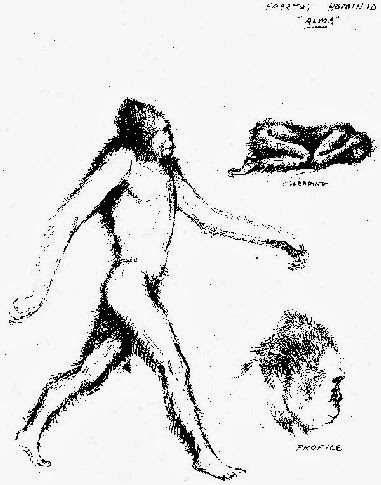
Old female almass are called by the people of Gobi 'zageen-emgen' - { here the translator admits defeat on the phrase --- the feeling is for the term to indicate a very old female creature who lives among rocky places }. According to the description, the almass are slightly stooped in posture, have bent knees, and arms longer than humans. They have long hair on the head, and their bodies are covered with short darkish hair. The females have long hanging breasts. The almass are not familiar with fire or firearms.
In the northern part of Mongolia, the name almass is almost unknown, as well as the names of the wild horses and camels. In the central part one may sometimes hear tales which were derived from lama folklore about almass being demonic creatures.
In the southern regions of Gobi, even though they have no wild horses, or camels, or almass, one may hear tales about chance meetings with them. In other regions, however, where all three species lived at the turn of the century, the stories are of a more concrete character. The rare instances where the almass was seen in 1930-1938 supports the idea that the creature is close to extinction now, and that a close relative of the Himalayan 'snow man' actually did live in the south-east of Mongolia during the early decades of this century, and is perhaps still existing in the far and remote regions seldom visited by people.
At any rate, these chance encounters with the almass in Mongolia support the thought that this close relative of the snow man inhabited Gobi and the mountains around it, and probably survived to the present time.
Accumulation of material in the places and regions of the ever-narrowing area of almass habitat will help in the study and clarification of this question. The tales about the hairy almass and the saxatile grand mother are so realistic, and the description of the few eyewitnesses are so vivid, that it is impossible to deny the existence of this distant relative of ours, who fell behind in his development, and at the present time is at the last stage of his existence. Like the wild horse 'takhi', and the wild camel 'khaptagai', the 'almass' is retreating before encroachment of the man who is gradually taking over large portions of the vast Gobi desert. "
Rinchen, writing in Contemporary Mongolia 1958.
I find that there is no way to read this without feeling, concurrently, optimistic that almass recently existed, and sad.
And now to his letter to the committee:
"I was so crowded with work that it was impossible for me to leave Ulan-Bator, nevertheless I have much interesting information.
A worker at the local fruit experimental station by name of Chimidorji, who was born in the south Gobi district, gave a student of mine, Badra, some interesting data about things which took place 20 or 25 years ago.
A monk by the name of Dambaiorin, a resident of south Gobi, was traveling by camel to Sudgin Gobi, and saw a naked child. Thinking that the child may have been lost, he came nearer and noticed that the child was covered all over with red hair. The monk realized that he was seeing a little almass, and in panic turned and ran for his life, because Mongolian monks consider the almass a supernatural creature.
About the same year and in about the same region of East Gobi, a local woman met, not too far from an ancient stone burial place, a naked almass child. She likewise turned and ran.
Also the same year, a man who was driving a herd of horses through the Nomogan pass was set upon by an adult female almass, but was able to get the best of her.
Another local woman who was tending sheep in about the same region, saw a little almass approaching her sheep and ran away abandoning her flock. The next day a neighbor of hers whose turn it was to tend sheep also saw apparently the same little almass.
In the eastern Gobi near the pass of the High Blue Mountains -- Undur Khukhu -- a local farmer was attacked by a male almass, but managed to gallop away, leaving behind one of his boots. A similar attack took place to the northeast in the Sumburin Pass.
According to Chimidorji, in all the above mentioned regions there is an abundance of information about numerous meetings between local residents and the almass. One may also find some residents who saw the almass, or were attacked by him.
According to Chimidorji, local trackers could find, in the regions once inhabited by the almass, their remains. How true it is, I don't know, but there is no doubt that the local farmers remember the almass who inhabited their region at the turn of the century.
I was told that the father and grandfather of one of the workers of the local base, in the general store, met with the almass in the Gobi regions.
Dorgisirun, an archaeologist of the historical institute told me recently, that in the late thirties of this century at his birthplace in northeast Mongolia, once in early spring, a naked hairy man wandered in and was driven away by the dogs. The women of the settlement decided that he was a cannibal. The farmers who attempted to pursue him followed his footprints and noticed that he stopped from time to time on elevated places. But they were unable to catch up with him. The footprints showed that this creature had widely spread toes. The spring of that year was a 'hungry' one and, because of lack of food, there appeared around the settlements many wild animals from Gobi not previously seen in those parts."
Ulan-Bator, March 8, 1959.
So... those were the direct inputs to the Snow Man Committee by the great man. Rinchen obviously believed the Almass to be real and his hypothesis was that it was a distant relative of humans dying out. He buttressed his views intelligently by integrating what he knew about palaeontology and biology and linguistics --- his Almass were a species which had grown in an ecology also containing the wild horse and camel, and he saw those connections as tight and beyond coincidence.
Generally, I've grown to like Rinchen --- a true in-the-heart Fortean, following a mystery in everything he did. Was he "right" about Almass being a different species rather than a dying micro-culture?
... hmmmm.... who knows ... there are some pretty impressive Mongolians.
Till next time ... maybe not for a while with this scanning project going, but I'll try.
Peace, folks.
Friday, February 21, 2014
Soviet Snowmen Study, Part Two.
Today here is a minimalist look into monograph #2 of the 4-volume set above that we introduced last time. To briefly remind: these are four very rare booklets containing information about a Soviet data-gathering committee's work on "wildman" possibilities in the Central Asian and China area, done in 1958-9. The monographs were published in 1959, and found their way to Ivan Sanderson's SITU Archives. He used them in preparation of his famous book. My esteemed European correspondent Theo Paijmans has informed me that these things were published in only about 100 copies, and, with likely attrition over the years, these are probably one of a very small number of sets left. Theo has asked me if I can scan them for the greater good, and I can't. If any of you out there want to come to Kalamazoo and do the scanning, I will be happy to open my doors for that.
My status so far, dwelling in these documents, is that I cannot read #1, since its translation in Ivan's notebook files is by Heuvelmans and only in French, and so I've begun with #2 [not a problem as these things are rather robotically assembled pieces of information "as they came" to the Committee with little analysis.]
So, I've finished #2 and will give you an idea with crude analysis of its contents now. Later, I have a few other words to say about this stuff; and then I'll close to go back to #s 3 and 4 for presenting to you in later postings as I can.
What did they find? [illustration is of the famous Bhutan ABSM stamps set, just to give you something pretty to look at.]
The booklet is broken up into 38 units of information, which represent pieces of data: interviews, letters, notes from lectures, extracted information from books. Sometimes within these pieces more than one incident, fable, or claim exists. It is almost impossible to decide whether to count certain things at all, but, idiosyncratically, I've decided that there are about 59 information bits here.
MUCH of those 59 are what we anomalies researchers would regard as extremely low-grade ore. In fact, there are almost no claims in booklet #2 which are really impressive. The way that the claims rise to something more than idle rumor is due to their accumulation, not their stand-alone strength. This "accumulation" has a bit more substance than it otherwise might, due to the extreme separation of the informants, and the apparent naivete of some of the people interviewed.

The things which are fairly universal in what they seemed to find are pretty much what we've come to assume to be true about this possible entity: The entity has a humanoid form, is bipedal, is naked, is covered with body hair, but with a "clean face." One could almost assume that these booklets created or at least fixed the general image for Almas, Wildman, Gul-Biavan, and all the other endless names.
Height surprised me a little. Firstly, less than half mentioned height at all. I have an itching suspicion about this. If the reporter didn't mention height, then there may have been nothing unusual about the height. This suspicion would be supported by the fact that in the 25 incidents where height was mentioned, 14 were normal human-sized in stature, and 9 were slightly taller. The two remaining cases were a long-distance estimation of a seven-footer through binoculars, using nearby plants for a yardstick, and a giant monster akin to the Amerindian Windigo creature folklore. When one adds to this the fact that a typical Mongolian male is about a little over five foot-to-five-and-a-half feet tall, few if any of Booklet #2 encounters may have been with anything over six-foot-tall.
Aggression: almost all reports that mentioned this said "no", not aggressive. Most said things like secretive or won't let you get too close. There were exceptions, of which I have my doubts. A few claims had a strong folk tale character about the female Almas being a threat to steal your baby, or the male being ready to steal a young girl for a wife. These steal-a-wife tales were accompanied by her having one or more babies, escaping or being let go after several years, returning "home" just to respond to "his" siren cry in the woods and leave again. Very folkloric.
One tale said the female monster liked to kill and drink blood --- so much for that.
Two tales from different areas in the Pamirs, had the Gul-Biavan come into a campfire area or a farm, and a big wrestling match ensued IN WHICH THE HUMAN WAS STRONGER AND WON. So much for giant size.....
As you probably see, my confidence in these odd tales of aggression is low. Any animal or man could be pushed into aggressive action, but I don't see that in this volume.
Hair Color: a variety though not all over the map. Most of the reports mentioning color have it as "dark" mainly brown, with almost no one saying specifically black. There is a gray strain in the reports, sometimes all over, sometimes like aging gray. And there is a bit more "reddish" reporting than I would have guessed.
Diet: almost everyone who talks of this says "small animals and meat." The creature will eat things it killed or "mountain roadkill" it finds. There are stories of it coming into a camp and accepting a cooked piece of goat [or whatever], but one story claimed it refused the roasted meat but accepted the raw.
Supplementing its carnivorous nature, a few reporters said [quite interestingly to me] that the Almas/ Gul-Biavan liked to kick over stones and grab the larger insects which lived beneath them. I thought it a correlation which wouldn't necessarily have been expected. Other folks spoke of "vegetable diets" without specificity.
A few additional things of who-knows-what significance: As the tales accumulated a trickle of cases began to show up wherein the creatures stunk badly --- not a lot, but a late trend in the booklet. One encounter was replete with footprints, and for a change, the reporter took a detailed look at them. He noticed an exceptionally large big toe, which might support Shipton's print [the report didn't say that, I did]. Also late in booklet #2, there was a small trend stating that the creatures walked "bent." I'd be careful of things like that, if only because the lead committee member was very interested in proving things about pre-humans and their "lifestyles" and ultimate ends, and the [erroneous] image of the Neanderthal was of a bent walker.
A last warning here: the word "gul-biavan" was very prominent in these reports, much more so than Almas, or the nearly non-existent Yeti ["yeti" precursors like MI-GE, MI-TE etc DID show up more]. The point here is that the locals called several sorts of animals "gul-biavan" most notably monkeys.
I've come away from this foray with a couple of understandings, I think. The first is that Sanderson seems to be the only English-language author to use this resource. He clearly used it as his notebook shows. He didn't exhaust it, because, I think, he like me saw that the translation still presented difficulties in understanding and mapping everything, and maybe it was best to just cherry-pick the best stories and integrate them as illustrations of what else he knew. Ivan was definitely a cherry-picker with this.
I looked at some other likely abominable snowman books, things like Izzard's thing, and more so Tchernine' In Pursuit of the Abominable Snowman, and Myra Shackley's Still Living. Both Tchernine and Shackley seemed prime possibilities for using this resource. Both apparently knew that something had happened with Porshnev's Committee, but neither seems to have used these booklets. Shackley knew about the Committee due to reading other writings of Porshnev, but not these monographs.
That made me wonder a bit too. Because Shackley's book so smoothly integrates with what I have read here, a strong aura of authenticity of research quality "in the field" resonates within it. I'm not usually a person who comes down on the "missing pages in the biological textbook" camp of cryptozoology [leaning to the paranormal usually, as you folks know] but this business looks like a very possible case of a relict population to me.
But, I believe, that one of the most likely environments for this relict survival is now gone.
Because of the concurrent Pamir expedition [which it turns out Porshnev himself was on], there is quite a lot of commentary about wildman legends/ rumors/ encounter tales from that region. Alongside some of the mountain ridges run rivers, wherein several wildman tales are placed. Some of these mountain are well vegetated and could support top predators high up the slopes. One river which showed up with favorable descriptors [I was impressed anyway] was the Kara-Balta. This begin to acquire a feeling for me of "ground zero."
Because I was becoming enamored of Kara-Balta as a potential Almas site, I went to good ole Google Maps to see if I could find it. Find it I did. Here in 2014 there are people and even roads everywhere. Cities exist; modern cities. How in the heck did THAT happen?
It ain't pretty.
At precisely the same time that the Moscow field workers were exploring the Pamirs, Uranium was discovered there --- sort of makes you wonder "who all" was on that mission and who paid for it, doesn't it? Well, you can fill in the blanks. The Kara-Balta area had just a little bit of Rubles poured into it and became the Soviet Union's #2 source of uranium for the Cold War.
Let's weigh this out: Uranium for nuclear bombs vs ecological space for relict populations? Hmmmmm. What would Stalin choose??
Now the mining has mainly stopped, leaving behind a thoroughly messed up environment and a large population trying to shift over [to Oil, I believe.] If Myra Shackley's neanderthal Almas were there in 1960, I doubt that they lasted long.
Somewhere else? Southwestern China? Maybe.
Now if Yeti looked like this, maybe we could get a Panda Campaign thing going.
Till next time, Peace, folks.
Monday, February 17, 2014
SNECHNOMA CHELOUEKE or something like that.
Well, so there you have it!
Have what, you say? Yep, same thing that I said. {Some of you out there might recognize what these are, but I wager not many}.
I was glancing at the Sanderson Archive stacks and there sat these four Russian-language monographs. Employing my usual zero-comprehension-of-non-English, I of course had no clue. Brilliant Sherlock Holmes quality inspection revealed the words " Committee on Informational Material for Investigating the Problem of the ABSM." That and the designators indicating that three of these publications were owned originally by Bernard Heuvelmans, George Agogino, and Tom Slick, pushed my feeble analytical abilities to the conclusion that these were Russian collections of Yeti/Almas information, and possibly used by Ivan in his famous book.
Well, OK. It's always nice to feel that one is holding a little piece of Cryptozoological history, but if I can't read it, that's as far as it goes. Fortunately for me [and maybe you] neither could Ivan.
Ivan knew that this was a big deal for him [I'd venture as guess that it was even a major inspiration for him deciding to write his masterpiece] and therefore was desperate for someone to translate for him. Heuvelmans sent him the first of the monographs and appears to have translated it himself --- BUT INTO FRENCH. Ummm... I'm screwed again. Weirdly, so, to a degree was Ivan [I say this because he's very labored about what he extracts from monograph #1].
My salvation came when I spotted a typical "Ivan Notebook" entitled: "ABSMs: USSR ACAD. SCI. BOOKLETS #1 to #4 AND ANALYSIS." Inside were the Heuvelmans French translation of #1, but, The Lord Be Praised!, English translations of the other three volumes. So maybe I could have a little fun afterall.
What I want to do here, since this turns out to be a bit of a reading, logging, thrashing about grind, is to blog an overview of what I'm reading so far in monograph #2 [remember I can't read Heuvelmans' French], and sort-of promise/hope to do a better job of presenting "case studies" sometime later.
What seems to have happened here is that in about 1958 [three years before Ivan published his big book], some Russians got so fired up about the enigma of the purported "wildmen" of Central Asia that they set up a committee in Moscow to collect information. The committee was headed by Dr. B.F. Porshniev [or Porshnev] [pictured above] and A.A. Shmakov. Porshnev seems to have been lead dog, and became a Sanderson correspondent at least to send Ivan book #4 ultimately.
Collecting of information was widespread: some done at headquarters with visitors, some of roads trips as far away as Mongolia, and some by letters and expedition reports. There was, simultaneously with the 1958-1959 period of information gathering, a Soviet expedition to the Pamir Mountains region in Kirghiz, and the committee had a lot of cooperation from this expedition, rather loading the "data" density towards that area, as well as I can see so far. [yeh I know that I shouldn't just plough into this before reading the whole thing, but if I don't I might never do it --- so let's just explore together and be surprised].
The presence of the expedition to the Pamirs also produced the feeling that the Pamirs were a focus site for potential continued existence of wildmen. A trickle of case reports along the Tibetan side of the Himalayas pointed to that area as a third possible hot zone. If one continued to follow the Marco Polo road to the East. one would enter the semi-legendary province of Shensi {Shaanxi}, home of the mysterious pyramids and the Xian terracotta warriors. From Xian, extending directly west, is a lengthy mountain range [the Tzinlin-Shan in the terms of this monograph] wherein a Chinese professor insisted that wildmen still existed.
Other tales dotted about the region. In China, the idea was that if one continued south of Shensi, one would enter the mountains of Sichuan and Yunnan, and the further one went into those mountains the more likely wildmen persisted. This intrigued me as this is prime location for the Rhododendron forests of southwestern China, wherein not only Yeti was supposed to live, but where romantics placed Shangri-la.
The last map-like thing that I want to comment about today is why I have a circle in the big desert marked "Tarim mummies". This may have no relevance to any of this or it might.
Porshnev interviewed the Director of the Nepalese museum who said that they had photographs of a "snowman child". The story went that a wealthy man in Katmandu had acquired a snowman child in mummified form. No comment was made as to where this mummy was found. The man brought the mummy to the museum, left it there briefly, during which time it was at least photographed. He then retrieved the mummy and it was never heard about since. The photographs reveal a baby, 8-10" long, male, dark skin, hairless, somewhat sunken eyesockets, somewhat elongated arms. The director's opinion was that it was neither monkey nor human.
This thought occurred to me: somewhere around 1960 or so, the academic world of the Soviet Union began getting interested in mummies said to exist in the central area of the Takla Makan Desert. The ultimate hullaballoo about these mummies is that they seem not to be oriental in body type, but rather European like. But that is not why the thought came up here.
I can readily imagine that if academe finally focussed on desert mummies in the 1960s, the locals knew about some of this decades earlier. Could some entrepreneur have carried a mummified Tarim baby, stillborn?, to Katmandu and sold it to a wealthy collector of arcane artifacts? It could, perhaps, explain a rather odd "data point" in this story.
This is a Tarim culture mask. What does it represent? I do not know of course. Looks pretty awesome to me... spirit creature? Wildman?
These Tarim people lived a long time ago, perhaps as deep into the past as 1800 BC. They were significantly taller than the locals also, which brings up another thought. And they gradually died out, perhaps as their ecology dried up.
Many concepts arise from this. Could some wildmen stories be the old knowledge of a tall and very different sort of people dwindling away? Could those people have retrogressed to cruder states of living as their surroundings became less hospitable? Or could the Tarim, just like everyone else in the region, have known of the wildmen and told stories of them and represented them as awesome creatures, just as an Amerindian living on the Pacific coast would? That mask brings back strong memories of the masks of the Kwakiutl people and their neighbors.
i'm going to stop here. I'm going to TRY to get through the entire monograph #2 and do something which presents the committee "data" such as it is --- these things are just one anecdote after another, and no synthesis by them.
... but that must come later and the future is cloudy.
Till then, Peace.
Labels:
Abominable Snowman,
Almas,
Bigfoot.,
Gul-Biavan,
Ivan Sanderson,
Yeti
Subscribe to:
Posts (Atom)
Followers
Blog Archive
-
▼
2020
(53)
-
▼
July
(10)
- SUMMA FAERYOLOGICA, part eleven
- SUMMA FAERYOLOGICA part ten.
- SUMMA FAERYOLOGICA, part nine
- SUMMA FAERYOLOGICA, part eight
- SUMMA FAERYOLOGICA, part seven
- SUMMA FAERYOLOGICA, part six
- SUMMA FAERYOLOGICA, part five
- SUMMA FAERYOLOGICA, part four
- SUMMA FAERYOLOGICA, part three
- SUMMA FAERYOLOGICA, part two
-
▼
July
(10)
Links
- A Different Perspective
- American Philosophical Library
- Caltech Archives
- Dr. J. Allen Hynek's Center for UFO Studies (CUFOS)
- Dr. Janet Quinn
- EXPLORE
- Frontiers Of Science
- Global Consciousness Project
- National Investigations Committee On Aerial Phenomena (NICAP)
- Robert G. Jahn, Ph.D.
- Smithsonian (SIRIS)